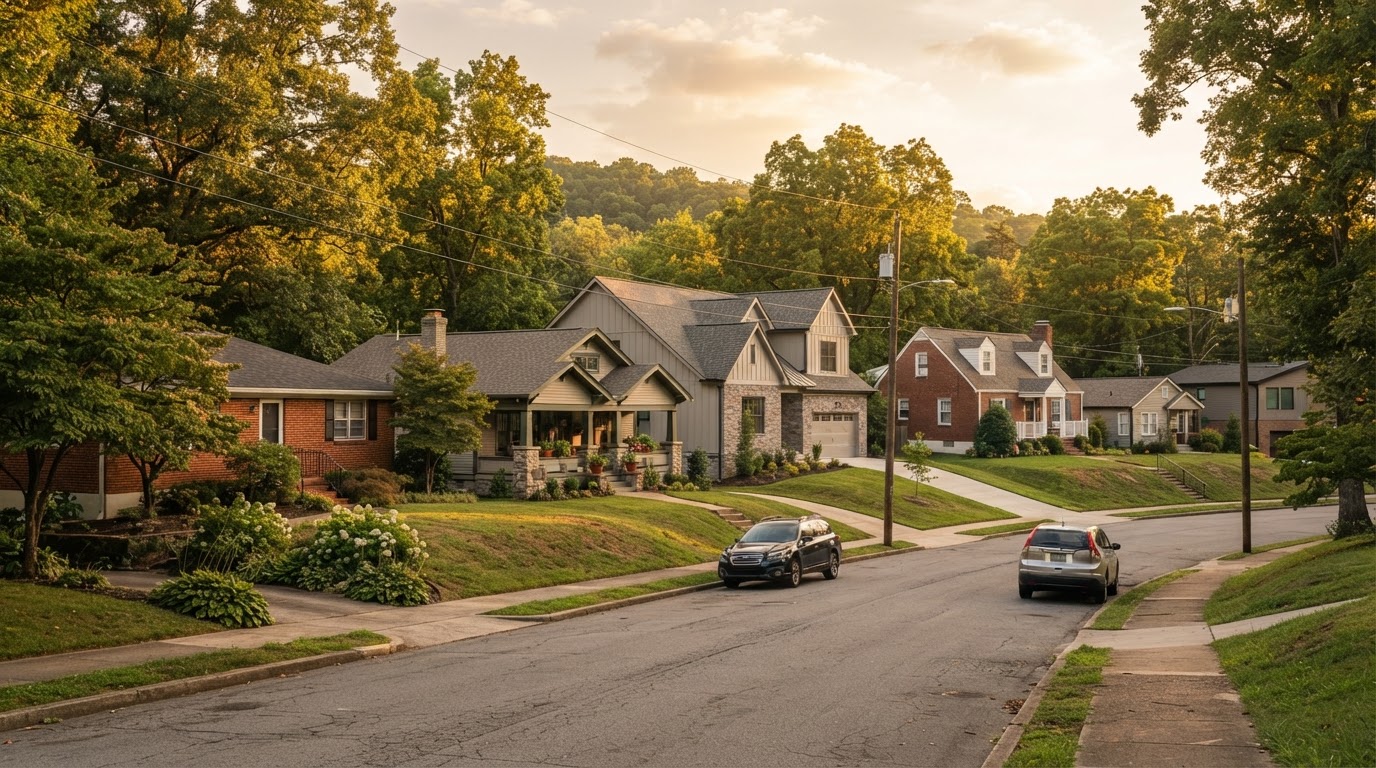
A Closer Look at Knoxville
Explore Knoxville Neighborhoods
Knoxville is often described by broad areas—West Knoxville, Northshore, Farragut, Hardin Valley or South Knoxville—but a broad location does not tell the whole story. Within each area are neighborhoods and subdivisions with different housing periods, architectural styles, lot characteristics, amenities, restrictions and relationships to the roads, parks, waterways and destinations around them.
These neighborhood guides are designed to help homeowners, buyers and people relocating to East Tennessee look more closely. They connect the character of an area with the property questions that can influence a real estate decision: how a home was built, how it has been maintained or changed, what belongs to the property, what may be governed by an association and what should be independently verified before relying on a neighborhood name or online description.
Use the broader Communities guides to understand Knoxville and East Tennessee. Use Neighborhoods when you are ready to compare particular residential areas and the homes within them.
From Community to Property
What a Neighborhood Guide Can—and Cannot—Tell You
A neighborhood guide can help explain the setting, housing patterns and questions commonly associated with an area. It cannot determine whether a particular property is the right fit, confirm a school assignment or establish legal boundaries, restrictions, utilities, insurance availability or future market performance.
In Knoxville and Knox County, a familiar neighborhood name may describe a recorded subdivision, a homeowners association, a historic district, a commonly understood area or a broader real estate search location. Those boundaries do not always align with ZIP codes, city limits, school zones or mailing addresses.
That is why these guides work at two levels. First, they provide useful local orientation. Then they identify the information that should be confirmed for the exact property under consideration.
Looking for the Broader Knoxville Story?
The Communities of Knoxville & East Tennessee section introduces regional character, housing context, parks, local destinations and practical considerations across Knoxville and nearby East Tennessee communities.
Begin With an Area
Twelve Knoxville-Area Neighborhood Guides
These guides focus on parts of Knoxville, Knox County and nearby East Tennessee communities where a broad area name includes several distinct neighborhoods, districts, buildings or subdivisions. Additional areas will be added as original, reliable information is completed.
West Hills & Bearden
Explore established West Knoxville neighborhoods shaped by different development periods, architecture, terrain and connections to Kingston Pike, Sutherland Avenue and nearby parks and greenways.
Neighborhoods introduced:
West Hills, Bearden, Forest Heights, Westwood, Deane Hill, Westmoreland, Westmoreland Heights, Rotherwood.
Explore West Hills & Bearden →
Northshore & Concord
Follow the Northshore and Concord corridor through established neighborhoods, waterfront and water-influenced settings, planned communities and properties with different access, topography, association and ownership considerations.
Neighborhoods introduced:
Rocky Hill, Sequoyah Hills, Lyons View, Kensington, Whittington Creek, Concord Hills, Arcadia Peninsula, Montgomery Cove, Wexford at Lake Loudon.
Explore Northshore & Concord →
Farragut
Look more closely at neighborhoods within and around the Town of Farragut, including established subdivisions, golf-oriented settings, newer communities and areas near parks, greenways and the western edge of Knox County.
Neighborhoods introduced:
Fox Den, Village Green, Bridgemore, Jefferson Park, Fox Run, Smithfield, Ivey Farms, Meadows on McFee, Hickory Creek, Saddle Ridge, Choto Landing.
Explore Farragut Neighborhoods →
Hardin Valley
Explore a growing part of northwest Knox County where established properties, newer subdivisions, construction activity, rolling terrain and access to Pellissippi Parkway create varied property and daily-travel considerations.
Neighborhoods introduced:
Hickory Creek, Covered Bridge, Glen at Hardin Valley, Hayden Hill, Braxton Creek, Vining Mill, Brighton Farms, Conners Creek.
Explore Hardin Valley Neighborhoods →
South Knoxville
Compare neighborhoods south of the Tennessee River, from established residential streets and older housing to areas influenced by parks, greenways, the Urban Wilderness and changing commercial corridors.
Neighborhoods introduced:
Island Home, Old Sevier, Colonial Village, Lakemoor Hills.
Explore South Knoxville Neighborhoods →
Downtown, Old City & University
Compare downtown condominiums, Old City lofts, historic university-adjacent homes and established central Knoxville neighborhoods through the documents, zoning, parking, renovation and ownership questions that shape each property.
Neighborhoods introduced:
Downtown Knoxville, Old City, Fort Sanders, Mechanicsville, Marble City, Beaumont, College Hills, Lonsdale, West View, Cumberland Avenue District.
Explore Downtown, Old City & University →
Historic North Knoxville & Fountain City
Explore locally protected historic districts, early suburban streets, established neighborhoods and Fountain City's varied housing through the preservation, renovation, terrain and older-home questions that shape each property.
Neighborhoods introduced:
Fourth & Gill, Old North Knoxville, Oakwood–Lincoln Park, North Hills, Fountain City, Whittle Springs, Belle Morris, Edgewood Park, Gibbs Drive, Harrill Hills.
Explore Historic North Knoxville & Fountain City →
East Knoxville
Compare historic city neighborhoods, established residential areas, golf-oriented settings and eastern Knox County properties through the renovation, zoning, jurisdiction, terrain and ownership questions that shape each address.
Neighborhoods introduced:
Parkridge, Holston Hills, Burlington, Morningside, Five Points, Chilhowee Park, Eastwood, Alice Bell–Spring Hill, Cold Springs, Riverdale.
Explore East Knoxville Neighborhoods →
Powell & Halls
Compare established neighborhoods, HOA communities, newer planned development and remaining rural-property patterns through the records, utilities, terrain and ownership questions attached to each address.
Neighborhoods introduced:
Powell, Halls Crossroads, Broadacres, Sterchi Hills, Timberlake, Belltown, Barrington, Beechwood Estates, Solomon Place, Temple Acres–Hallsdale.
Explore Powell & Halls Neighborhoods →
Gibbs & Corryton
Compare rural acreage, established homes, growing subdivisions and House Mountain- and river-influenced settings through the land, utility, access and ownership questions attached to each property.
Neighborhoods introduced:
Gibbs, Corryton, Harbison Crossroads, Plainview, Gibbs Estates, Fairview Village, Hillwood Heights, House Mountain Farms, Holston River Preserve, Honey Oaks.
Explore Gibbs & Corryton Neighborhoods →
Cedar Bluff, Walker Springs & Ebenezer
Explore 40 West Knoxville neighborhoods and subdivisions through the property records, renovation histories, restrictions and ownership questions that distinguish one address from another.
Neighborhoods introduced:
Benington, Bexhill, Cedar Bluff, Crestwood Hills, Farmington, Gettysvue, Gulf Park, Gulfwood, Plantation Springs, Seven Oaks, Walker Springs, Westland Oaks.
Explore Cedar Bluff, Walker Springs & Ebenezer →
Karns, Ball Camp & Northwest Knox County
Explore established subdivisions, growing residential areas and broader community identities across Karns, Ball Camp and Northwest Knox County—with local property context for sellers, buyers and relocating households.
Neighborhoods introduced:
Karns, Ball Camp, Bakertown, Byington, Byrd Chapel, Copper Ridge, Copperfield, Robinson Crossroads, Tekoa, Treeville.
Explore Karns, Ball Camp & Northwest Knox County →
Additional area guides will be published as complete neighborhood content becomes available. The areas above represent the planned structure of the Neighborhoods section.
More Than a List of Places
The Homes Behind the Neighborhood Names
Two homes within the same neighborhood may differ substantially. One may retain original materials and systems; another may have been expanded or extensively renovated. Nearby properties may have different topography, drainage, utility arrangements, association obligations, access rights or relationships to water and recreation.
Each guide will look beyond general descriptions to consider the real estate details that can shape ownership and a future sale:
- Housing styles and broad development periods
- Original, updated and substantially renovated properties
- Lot, street and terrain characteristics
- Additions, permits and improvement records
- Homeowners associations, amenities and restrictions where applicable
- Utility, access, drainage and insurance questions that may be property-specific
- Waterfront, water-view and water-access distinctions where relevant
- Information a buyer should independently verify
- Records and preparation that may help a seller present the property clearly
The purpose is not to label one neighborhood as better than another. It is to help people ask better questions before making a property decision.
Start From Where You Are
Guidance for Homeowners, Buyers and People Relocating
For Homeowners and Potential Sellers
A homeowner may begin researching long before deciding to sell. Neighborhood-level information can help frame the questions buyers may bring to the property, but preparation should never be based on a neighborhood stereotype. The right plan depends on the individual home, its condition, improvements, documentation and the owner's timing and priorities.
Denise can help identify which property details deserve attention, which records may strengthen buyer confidence and whether a proposed improvement is likely to support the homeowner's real estate goal.
For Buyers
A neighborhood name is a useful starting point, not a substitute for evaluating the actual home. Buyers should confirm jurisdiction, school assignment, taxes, utilities, insurance, restrictions, association obligations, renovation history and other property-specific conditions before making a decision.
These guides will help buyers understand what to investigate and how nearby neighborhoods may differ without directing them toward a predetermined answer.
For People Relocating to East Tennessee
Relocating buyers often begin with names encountered online, recommendations from friends or a map that makes nearby places appear interchangeable. A more useful comparison begins with everyday priorities: the type and age of home, maintenance expectations, routes to important destinations, outdoor access, services and the people or places the buyer needs to reach.
Use the Communities guides for regional orientation and these Neighborhoods guides for a closer look at residential areas and property patterns.
Verify the Exact Address
Understanding School Information
School assignments are an important research question for some buyers, but neighborhood names, subdivision names, ZIP codes and mailing addresses do not establish attendance zones. Portions of a broader area may be served by different schools, and boundaries or programs can change.
Each neighborhood guide will identify the applicable public school system and link to its official zoning resources. When relevant, a guide may name schools that serve portions of the broader area, but buyers should confirm the assignment for the exact property directly with the school system before making a housing decision.
School information on this site is provided for factual orientation. Denise does not rank schools or use school reputation to determine which neighborhood is appropriate for a person or household.
How Denise Approaches Neighborhood Guidance
Local Knowledge Should Lead to Better Questions
Knowing Knoxville is not simply memorizing subdivision names or describing what is nearby. Useful local guidance connects the setting with the property itself.
When Denise helps someone compare neighborhoods, she also listens for the practical details behind the search: how the home needs to function, how much maintenance feels realistic, which routes and destinations matter, whether an established or newer property is preferred and what ownership questions deserve investigation.
For a homeowner, the same knowledge works in reverse. Denise considers how buyers may compare the property, which features need explanation, what documentation may matter and how preparation can support the owner's goals without turning every pre-sale conversation into a list of renovations.
The first conversation does not require a final decision. It is an opportunity to make the next question clearer.
Questions & Answers
Frequently Asked Questions
What is the difference between a Knoxville community and a neighborhood?
On this site, a community guide provides broader regional orientation, including local destinations, parks, housing context and connections to surrounding areas. A neighborhood guide looks more closely at named residential areas, housing patterns and property questions. Local usage is not always formal, so exact boundaries and property details should be independently verified.
Are neighborhood boundaries official?
Not always. A name may refer to a recorded subdivision, homeowners association, historic district, commonly understood area or real estate search location. Those boundaries may not match city limits, ZIP codes, school zones or mailing addresses.
Will every neighborhood listed have its own page?
The initial pages group related neighborhoods within ten broader areas. This provides useful depth without creating short, repetitive pages. A neighborhood may receive its own page later when enough original, reliable information exists to support a genuinely helpful guide.
Can these guides confirm school assignments?
No. The guides can identify the applicable school system and provide official research links. Buyers should verify the current assignment for the exact property directly with the school system.
Will the neighborhood pages include current homes for sale?
LivingKnoxvilleTN.com is designed primarily as an educational resource. When a property-search path is useful, the page may link to DeniseYeoRealtor.com, where current listing information and search tools are available.
How can a homeowner use a neighborhood guide before selling?
The guide can help a homeowner understand how the property fits within the surrounding housing stock and which records or condition questions buyers may raise. A property-specific conversation with Denise can then help determine what preparation supports the owner's goals and what work may be unnecessary.
Can Denise help someone compare neighborhoods while relocating?
Yes. Denise can help a relocating buyer move from broad preferences to property-specific questions involving housing type, maintenance, routes, services, outdoor access and the places or people the buyer needs to reach.
Begin With a Conversation
A Neighborhood Name Is Only the Beginning
The most useful real estate guidance moves from the map to the specific property and from a list of features to the decision a person is trying to make.
Whether you own a Knoxville home, are comparing neighborhoods or are preparing to relocate to East Tennessee, Denise can help organize the questions, identify what needs to be verified and create a practical next step.